


Ever tried to name a character, a pet, or even a new username and every normal name felt too plain for the mood you wanted? That’s the exact spot where gothic names step in. Below you’ll find over 271 dark, beautiful, and mysterious names sorted into easy categories, so you can find the perfect match in minutes.
You’ll learn where gothic names actually come from, how to pick one that fits your story or style, and how to build your own from scratch.
Standout Names
These are the names that just hit different the second you hear them. They carry weight, a little shadow, and a lot of personality, which is why they show up again and again in gothic stories, goth culture, and dark fantasy worlds.
- Ravenna – tied to the raven, a bird linked with mystery and omens
- Mortimer – old French roots meaning “still water,” but the sound feels anything but calm
- Lilith – a name from ancient myth, tied to independence and night
- Thorne – sharp, simple, and a little dangerous
- Ambrose – Greek for “immortal”
- Selene – the Greek moon goddess
- Dorian – made famous by dark literature, tied to beauty and vanity
- Nyx – the Greek goddess of night
- Vesper – Latin for “evening”
- Cassius – Latin, meaning “empty” or “hollow,” with a strong sound
- Wednesday – linked to Odin’s day and a famous gothic character
- Raven – the bird itself, dark and clever
- Damaris – a name with quiet, old-world mystery
- Bellamy – French for “beautiful friend,” softened with a dark twist
- Draven – a fresh invented name that sounds carved from shadow
- Isolde – from medieval legend, tragic and romantic
- Grim – blunt, bold, and unmistakably dark
- Seraphine – from “seraphim,” angelic yet eerie
- Alaric – Germanic for “ruler of all”
- Marlow – English, meaning “driftwood,” with a moody edge
Story Behind Gothic Naming
Gothic naming didn’t start with black eyeliner and velvet jackets. It goes back to the actual Gothic tribes of ancient Europe, groups like the Visigoths and Ostrogoths, whose names were built to sound strong and unshakable. Centuries later, Gothic architecture (think tall cathedrals, pointed arches, stained glass) borrowed that same word, “Gothic,” to describe something dramatic and larger than life.
Then came Gothic literature in the 1700s, full of haunted houses, cursed families, and moody heroes, and the name style shifted again toward mystery and shadow. By the time the goth subculture showed up in the late 1970s, the word had already picked up centuries of drama, darkness, and romance. That’s the real reason a gothic name feels different from a regular one. It’s not random, it’s the sound of history layered on top of history.
Best Gothic Fantasy Names
Fantasy worlds run on names like these, built for characters who feel bigger than life.
- Morrigan – a war goddess from Celtic myth
- Alistair – Scottish, meaning “defender of mankind”
- Vashti – Persian, meaning “beautiful woman”
- Nightshade – taken straight from the poisonous plant
- Ravyn – a stylized spin on raven
- Zoraida – Arabic-rooted, tied to dawn
- Malachai – Hebrew, meaning “messenger”
- Elowen – Cornish for “elm tree”
- Grimwald – Germanic, meaning “dark ruler”
- Thessaly – pulled from an ancient Greek region
- Caradoc – Welsh, meaning “beloved”
- Nyxandra – a stylized blend of “Nyx” and “Andra”
- Umbriel – a moon of Uranus, meaning “shadow”
- Corvinus – Latin, tied to the raven
- Wraithe – a stylized take on “wraith”
- Xandria – a bold, invented variant of Alexandria
- Belladonna – Italian for “beautiful lady,” also a deadly flower
- Sableheart – built from “sable,” meaning black fur
- Vessalius – inspired by old anatomical Latin names
- Elspeth – Scottish form of Elizabeth, quietly haunting
Cool Gothic Name Ideas
Short, punchy, and easy to say out loud, these names work for characters, usernames, or pets.
- Onyx – the black gemstone
- Raze – meaning to tear down
- Crow – the bird, clever and dark
- Jinx – tied to bad luck and mischief
- Reven – a stylized spin on raven
- Sable – black fur, often used for names
- Storm – wild and unpredictable
- Blackwood – literally, dark wood
- Ash – remains of fire
- Cinder – a burnt ember
- Fang – sharp and animal
- Rune – ancient carved symbols
- Shade – a shadow or ghost
- Nocturne – a piece of music written for the night
- Wolfe – stylized spelling of wolf
- Slate – dark gray stone
- Grave – blunt and heavy
- Ember – a glowing coal
- Fenwick – Old English, meaning “marsh farm,” with a rough sound
- Kade – short, sharp, and current
Gothic Boy Names
Strong, old-world sounds that fit dark heroes or real babies alike.
- Godric – Old English, meaning “God’s power”
- Rurik – Old Norse, meaning “famous ruler”
- Bram – short for Abraham, made famous by the author of Dracula
- Draco – Latin for “dragon”
- Killian – Irish, meaning “little church” or “war”
- Malcolm – Scottish, meaning “servant of Columba”
- Roderick – Germanic, meaning “famous power”
- Bastian – short for Sebastian, meaning “venerable”
- Cyprian – Latin, tied to the island of Cyprus
- Emeric – Germanic, meaning “work ruler”
- Frost – a nod to cold and winter
- Garrick – English, meaning “spear ruler”
- Hollis – Old English, meaning “near the holly trees”
- Ignatius – Latin, meaning “fiery”
- Jarek – Slavic, meaning “born in January” or “fierce”
- Konrad – Germanic, meaning “bold advisor”
- Lucian – Latin, meaning “light,” ironic for a dark name list
- Maddox – Welsh, meaning “son of Madoc”
- Nero – Latin, meaning “strong” or “black”
- Osric – Old English, meaning “divine ruler”
Goth Girl Names
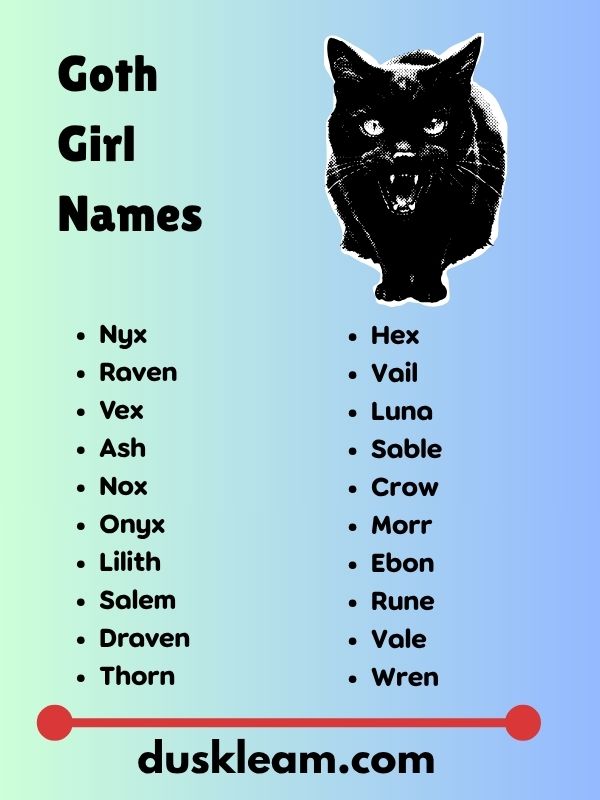
Soft sounds with a sharp edge, perfect for a character or a real baby girl.
- Morticia – popularized by a famous fictional gothic mother
- Salem – tied to the historic Massachusetts town
- Persephone – Greek goddess of the underworld
- Luna – Latin for “moon”
- Delphine – French, meaning “dolphin,” softer than it sounds
- Evangeline – Greek, meaning “bearer of good news”
- Mercy – a virtue name with a heavy feel
- Circe – a Greek sorceress from mythology
- Astrid – Old Norse, meaning “divinely beautiful”
- Blythe – Old English, meaning “free spirit”
- Cressida – Greek, tied to a tragic love story
- Desdemona – from Shakespeare, meaning “ill-fated”
- Freya – Norse goddess of love and war
- Ismene – Greek, from the story of Antigone
- Jezebel – Hebrew, tied to a bold biblical queen
- Kassandra – Greek, a prophetess nobody believed
- Larkspur – a tall purple flower name
- Marnie – English, meaning “from the sea”
- Ondine – French, meaning “little wave” or water spirit
- Rosalind – Old German, meaning “gentle horse,” used in Shakespeare
Click Here To Read More…
Catchy Gothic Baby Names
Real, wearable names that still carry a dark and dreamy sound.
- Winter – the coldest season
- Hollow – an empty, echoing space
- Moon – simple and celestial
- Grey – a color right between black and white
- Vale – a low valley, quiet and shaded
- Thornea – a softened spin on “thorn”
- Ashling – Irish, meaning “dream” or “vision”
- Briar – a thorny wild plant
- Wrenna – a feminine take on the small bird
- Twilight – the hour between day and night
- Lark – a songbird known for its early call
- Roan – a reddish-brown horse color
- Marlowe – English, meaning “driftwood”
- Fable – a short story with a lesson
- Wisteria – a trailing purple flowering vine
- Halloway – inspired by the word “hallow”
- Corvina – a feminine twist on the raven root “corvus”
- Merrow – Irish for mermaid
- Bramwell – English, meaning “bramble spring”
- Sorren – a soft, invented name with a somber tone
Creative Names For Goth
For when you want something nobody else has ever used.
- Umbra – Latin for “shadow”
- Nightingale – the bird known for its haunting night song
- Duskwood – built from “dusk” and “wood”
- Moonbramble – a blend of moon and thorny bramble
- Grimshade – a mix of grim and shade
- Wraithewood – stylized and invented, ghost-like
- Ashgrave – blending ash and grave
- Silverfang – sharp and metallic
- Ravensong – the raven paired with song
- Duskfire – contrast of dark and flame
- Nocturnia – a stylized, invented version of “nocturnal”
- Shadowmere – shadow plus “mere,” an old word for lake
- Willowdark – a willow tree with a dark twist
- Frostbane – built to sound like a weapon or curse
- Emberfell – fire paired with a fall
- Hollowbrook – an empty stream
- Cindergate – a burnt entryway
- Thornveil – thorn plus veil, sharp and hidden
- Wickervale – a woven valley
- Ravenwhisper – the raven paired with a whisper
Funny Gothic Names
Not every dark name has to stay serious, some are built purely for a laugh.
- Count Snugglefang – a vampire who just wants a hug
- Batty McBatface – self-explanatory
- Sir Doom-a-lot – dramatic and proud of it
- Gloomy Gus – the classic sad-sack nickname
- Misty Von Mope – built for maximum sulking
- Baron Von Broody – a title made for eye-rolling teens
- Countess Cranky – royalty with zero patience
- Spookington – sounds like a haunted town, not a person
- Ghoul Gary – a ghoul with an ordinary name
- Wendell Wraith – a wraith who sounds like your accountant
- Damp Dracula – the least intimidating vampire around
- Frankie Furter – a monster-adjacent hot dog pun
- Zombie Zach – undead, but still just a Zach
- Creepella – a diva with a spooky flair
- Doomsworth – a last name that takes itself too seriously
- Pumpkin Poe – a nod to Edgar Allan Poe, minus the drama
- Sir Coffin-a-lot – built for a very tired knight
- Moldy Morticia – a gothic name that skipped laundry day
- Bram Stroker – a very relaxed cousin of Bram Stoker
- Vlad the Impatient – a vampire who hates waiting in line
Gothic Last Names
Pair these with any first name above for extra weight.
- Darkholt – dark plus an old word for forest
- Ravencroft – raven plus a small farm
- Ashworth – “worthy of ash”
- Grimshaw – grim plus a small wood
- Thornbury – thorn plus fortified town
- Wraithmoor – ghost plus open moorland
- Duskmore – dusk plus “moor”
- Coldwell – a cold water source
- Vaneheart – vane plus heart, wind-worn and warm underneath
- Hollowell – a hollow well
- Sableton – black plus town
- Moonraven – moon paired with raven
- Wychwood – an old English word for a bending forest
- Graveley – grave plus meadow
- Emberstone – ember plus stone
- Corvane – stylized from “corvus,” the raven family
- Frostgate – frost plus entryway
- Ashbourne – ash plus stream
- Wolfsbane – the poisonous plant, used as a surname here
- Nightborne – born of the night
Traditional & Magical Gothic Names
Old-world names pulled from myth, folklore, and centuries of storytelling.
- Morgana – the sorceress from Arthurian legend
- Merlyn – a stylized spelling of the famous wizard’s name
- Hecate – Greek goddess of magic and crossroads
- Yagara – a name inspired by old Slavic witch folklore
- Rowan – tied to the rowan tree, said to ward off evil
- Elphaba – inspired by classic witch storytelling
- Aradia – tied to Italian witchcraft folklore
- Faelan – Irish, meaning “little wolf”
- Gwyneira – Welsh, meaning “white snow”
- Isadora – Greek, meaning “gift of Isis”
- Nimue – the Lady of the Lake from Arthurian legend
- Oberon – king of the fairies in old folklore
- Titania – queen of the fairies
- Cerridwen – Welsh goddess tied to a magical cauldron
- Ysolde – a medieval variant of Isolde
- Bellweather – built from “bell” and “weather,” old and folkloric
- Wilhelmina – Germanic, meaning “resolute protector”
- Thistlewood – a spiky plant paired with wood
- Aelric – Old English, meaning “elf ruler”
- Sigourney – Old French, meaning “daring king”
Dark Gothic Names And Their Meanings
Some names carry meanings that are dark on the surface and deep underneath.
- Morrow – meaning “tomorrow,” oddly hopeful for a dark name
- Sorrow – grief, worn as a name with pride
- Requiem – a musical piece written for the dead
- Elegy – a poem of mourning
- Obsidian – volcanic glass, black and sharp
- Ravage – to destroy completely
- Vanth – an Etruscan death goddess
- Charon – the ferryman of the underworld in Greek myth
- Azrael – a name tied to the angel of death in folklore
- Thanatos – the Greek personification of death
- Wraith – a ghost or spirit
- Banshee – an Irish spirit whose wail warns of death
- Erebus – the Greek personification of darkness
- Melancholy – deep, quiet sadness
- Requiemme – an invented soft variant of requiem
- Doleful – meaning sorrowful, used here as a bold name choice
- Cindra – built from “cinder,” meaning the last of a fire
- Vantablack – named after the darkest man-made material
- Nightmare – blunt, and impossible to misread
- Lament – an expression of grief or regret
DnD Gothic Names
Built for tabletop characters who need a name as strong as their backstory.
- Kaelthorne – a blend of “Kael” and “thorn”
- Vardis – short, sharp, and easy to shout across a table
- Zaltharion – long and dramatic, built for a wizard
- Morvane – inspired by “mor” (death) and “vane”
- Threnody – a song of mourning, unusual as a character name
- Kestrik – a sharp, bird-inspired invented name
- Ravendark – simple and to the point
- Sylas Grimm – a rogue-sounding first and last name combo
- Duskryn – dusk plus a hard consonant ending
- Nyctari – built from “Nyx,” the goddess of night
- Voss Thornwood – a ranger-sounding full name
- Ilyndra – a soft, elvish-feeling invented name
- Grendel – borrowed from old epic poetry
- Baelric – Germanic-inspired, meaning “bold ruler”
- Corvex – built from the raven root “corvus”
- Malrick – a blend of “mal” (bad) and “rick” (ruler)
- Wintermourne – winter plus mourning
- Ashkarion – a fire-and-ash inspired invented name
- Drusilla Vane – a bard or noble-sounding full name
- Kethran – short, guttural, built for a barbarian
Ancient Gothic Names
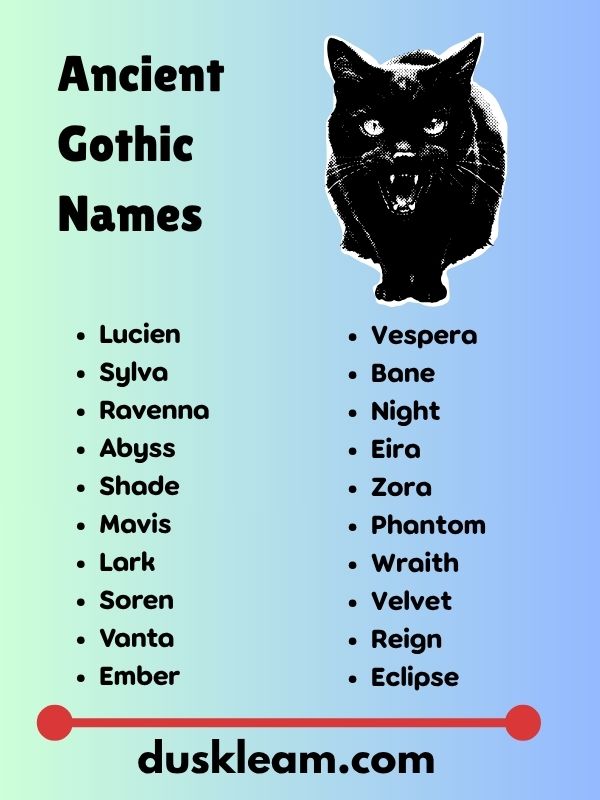
Pulled from the real history of the Gothic tribes, the actual root of the word “Gothic.”
- Athanaric – a real historic Gothic king’s name
- Theodoric – meaning “ruler of the people,” a real Ostrogothic king
- Fritigern – a real Visigothic leader’s name
- Totila – meaning “immortal,” a real Ostrogothic king
- Athaulf – a Visigothic king’s name, meaning “noble wolf”
- Sigismund – Germanic, meaning “protection through victory”
- Gundahar – Germanic, meaning “battle warrior”
- Radagaisus – a historic Gothic military leader’s name
- Vitiges – a real Ostrogothic king’s name
- Amalasuntha – a real Ostrogothic queen’s name
- Brunhild – a legendary Germanic warrior queen
- Ermanaric – a real Gothic king from ancient history
- Theodahad – a real Ostrogothic king’s name
- Wallia – a real Visigothic king’s name
- Sunilda – a Gothic name tied to old legend
- Gaina – a Gothic military leader from late Roman history
- Hunimund – a real Gothic king’s name
- Vidimir – a real Ostrogothic royal name
- Thiudimir – a real Ostrogothic royal name, father of Theodoric
- Valamir – a real Ostrogothic king’s name
Gothic Era Names
Names that feel like they belong inside a cathedral, carved in stone.
- Cathedra – built from “cathedral”
- Spire – the pointed top of a Gothic building
- Vaulted – describing an arched ceiling
- Gargoyle – the carved stone creatures on old buildings
- Buttress – the stone supports on cathedral walls
- Rosewindow – inspired by the round stained glass windows
- Chantry – a small chapel, quiet and shadowed
- Cloister – a covered walkway in old buildings
- Nave – the main body of a cathedral
- Transept – the crossing section of a cathedral
- Ogive – the pointed arch shape common in Gothic design
- Tracery – the stone framework inside a Gothic window
- Belfry – the bell tower of an old church
- Crypt – the underground chamber below a church
- Parapet – a low protective wall on a rooftop
- Finial – the decorative tip on a spire
- Buttercross – an old market cross, weathered and worn
- Gable – the triangular wall section under a roof
- Chalice – a ceremonial cup
- Portal – a grand entrance, often carved with figures
Famous Gothic Historical Names
Real figures whose names are permanently tied to the Gothic and gothic-literature world.
- Poe – after the writer known for dark, moody stories
- Stoker – after the author who wrote the most famous vampire novel
- Shelley – after the author of a famous gothic monster tale
- Radcliffe – after an early gothic-novel pioneer
- Walpole – after the writer credited with starting the gothic novel genre
- Lovecraft – after the writer known for cosmic horror
- Poeska – a stylized name inspired by “Poe”
- Byronic – built from the poet whose brooding heroes shaped the genre
- Brontë – after the literary family behind several gothic classics
- Le Fanu – after an early vampire-fiction author
- Maturin – after the author of a classic gothic wanderer tale
- Hoffmann – after a writer known for dark fairy-tale fiction
- Collins – after a novelist known for mystery and suspense
- Ashbrooke – a variant nod to a classic horror-writer style surname
- Machen – after a writer known for supernatural horror
- James M. – a nod to a classic ghost-story author’s initials
- Ann R. – a nod to an early gothic-novel pioneer’s initials
- Vathek – the title character from an early gothic novel
- Melmoth – the title character from a classic gothic wanderer tale
- Otranto – taken from the castle in the first gothic novel
Victorian Gothic Names
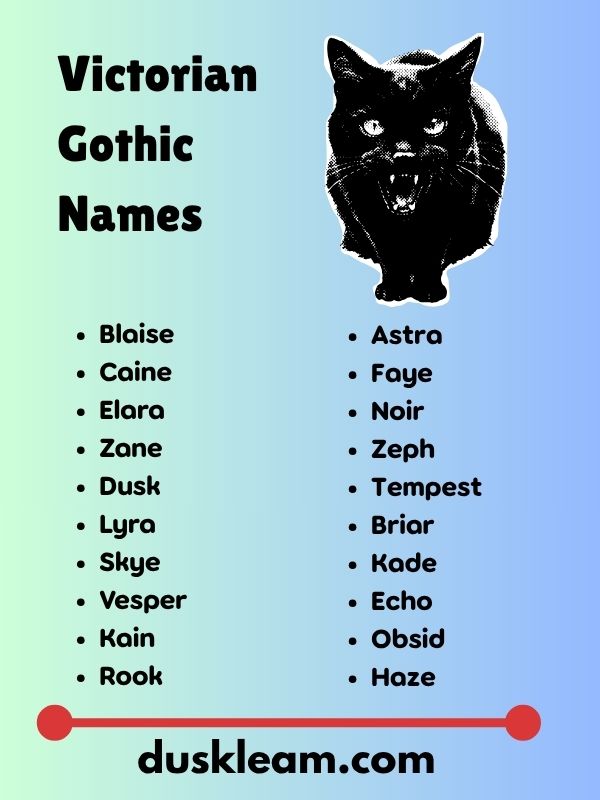
Formal, layered names straight out of a candlelit Victorian drawing room.
- Edwina – a formal, feminine Victorian classic
- Percival – Arthurian and Victorian at once
- Millicent – Germanic, meaning “strong in work”
- Reginald – Germanic, meaning “counsel power”
- Constance – a virtue name meaning steadfast
- Wentworth – a grand old English surname turned first name
- Beatrix – Latin, meaning “bringer of joy,” used for tragic Victorian heroines too
- Cornelius – Latin, an old-money sounding name
- Prudence – a virtue name, common in Victorian fiction
- Sylvester – Latin, meaning “of the forest”
- Henrietta – a formal feminine take on Henry
- Barnaby – English, playful yet old-fashioned
- Octavia – Latin, meaning “eighth”
- Ambrosine – a feminine take on Ambrose
- Cuthbert – Old English, meaning “famous and bright”
- Theodora – Greek, meaning “gift of God”
- Alfreda – Old English, meaning “elf counsel”
- Ezra Wentmoor – a full invented Victorian-style name
- Josephine – French, meaning “God will add”
- Cassandra Vane – a full invented Victorian-style name
Gothic Vampire Names
Names built for creatures of the night, elegant and a little dangerous.
- Lestat – a name made iconic by vampire fiction
- Carmilla – from one of the earliest vampire novels
- Nosferatu – taken straight from the classic silent film
- Akasha – meaning “sky” in Sanskrit, used for ancient vampire lore
- Marius – Latin, meaning “of Mars,” warlike and old
- Armand – French, meaning “soldier”
- Claudia – Latin, tied to a tragic vampire story
- Louis Pointe – a full invented vampire-style name
- Elisabeta – a stylized, old-world feminine name
- Radu – Romanian, tied to real Wallachian royal history
- Mircalla – the anagram name used in early vampire fiction
- Ianthe – Greek, meaning “violet flower”
- Kallista – Greek, meaning “most beautiful”
- Damaskus – inspired by the ancient city of Damascus
- Vesperine – built from “vesper,” meaning evening
- Nightwalker – blunt and self-explanatory
- Crimsona – built from the color crimson
- Bloodmoon – a lunar event turned into a name
- Fangor – short, sharp, invented
- Duskbite – blending dusk and bite
Gothic Nicknames And Username
Perfect for social media, gaming, or a quick nickname that still feels dark and mysterious.
- RavenXO – simple and easy to remember
- NoctisQueen – Latin “night” plus royalty
- ShadowVeil – mysterious and layered
- GrimGhoul – playful alliteration
- MoonlitFang – romantic yet sharp
- DuskRider – built for gaming handles
- VelvetCrypt – soft word paired with a heavy one
- WraithWhisper – quiet and eerie
- OnyxHowl – stone plus sound
- PhantomBloom – a ghost paired with a flower
- AshenRose – burnt and beautiful together
- CrowsNestX – a nod to a raven-family bird
- BleakBeauty – a contrast pairing
- HollowMoonX – empty plus celestial
- NightVeilXO – simple, dark, easy to type
- RustedHalo – a fallen-angel style handle
- EmberWraith – fire plus ghost
- ThornKissed – sharp plus soft
- MidnightMourn – time plus grief
- VenomVeil – danger plus mystery
Unique One Word Names For Gothic
Sometimes one word says everything you need.
- Solstice – the point where day and night balance
- Eclipse – when light disappears completely
- Nocturna – built from “nocturnal”
- Bramble – a wild, thorny plant
- Jetblack – straightforward and bold
- Phantasm – meaning a ghostly vision
- Hush – total silence
- Bane – a source of harm or ruin
- Veil – a thin covering that hides
- Gloom – dim, heavy darkness
- Mourn – to grieve deeply
- Fade – to slowly disappear
- Tombe – inspired by “tomb”
- Chill – a cold, sharp feeling
- Haze – a soft blur in the air
- Void – complete emptiness
- Ruin – what’s left after destruction
- Soot – burnt residue, heavy and dark
- Wither – to slowly weaken and fade
- Echo – a sound that repeats and fades
Good & Modern Names With Gothic Style
For readers who want the mood without the medieval spelling.
- Raven Sky – a fresh two-word combo
- Jett – short, sharp, and stylish
- Storme – a stylized fresh-feeling spelling
- Kai Ash – short and current
- Nova Grey – celestial plus color
- Zaria – invented, soft, and current
- Kade Wolfe – fresh first, dark last
- Willa Night – soft first name, bold last
- Ryker – current and sharp-sounding
- Sable Rae – classic dark word plus a lighter middle name
- Onyx James – stone name plus classic middle
- Dax Storm – short and punchy
- Lyra Vane – celestial plus invented surname
- Rowan Blake – nature name plus color-based surname
- Wren Ashby – bird name plus place-style surname
- Cove Winter – place word plus season
- Sage Thorne – herb name plus sharp surname
- Vesper Lane – time-of-day name plus street-style surname
- Ash Kellan – short first plus invented last
- Nyla Cross – fresh first plus symbolic last
Themed-Inspired Names for Gothic
Grouped around a single mood or image, useful when you want a matching set.
Moon-Themed
- Lunaria – a plant named for the moon
- Selenia – built from Selene, the moon goddess
- Cressent – a stylized spin on “crescent”
Raven-Themed
- Corvidae – the scientific bird family name
- Ravel – short and sharp
- Crowe – a stylized spelling of crow
Shadow-Themed
- Umbrielle – a softened, feminine spin on “Umbriel”
- Shaded – straightforward and bold
- Duskara – invented, blending dusk and a soft ending
Storm-Themed
- Tempest – a violent storm
- Squall – a sudden, sharp storm
- Thunderclad – built to sound armored and loud
A – Z Names For Gothic
One dark name for every letter, so nobody’s left out.
- A – Azriel – a variant of the angel-of-death name
- B – Balthazar – one of the traditional biblical magi names
- C – Cyllene – a Greek mountain nymph’s name
- D – Drusilla – Latin, meaning “strong”
- E – Ebonwyn – built from “ebony”
- F – Fenrisa – inspired by the wolf Fenrir from Norse myth
- G – Griselda – Germanic, meaning “grey battle”
- H – Hadesia – built from Hades, god of the underworld
- I – Ianthar – an invented, jewel-toned name
- J – Jorah Vane – short and grounded
- K – Kestrel – a small, fierce falcon
- L – Lachrymose – meaning tearful, unusual as a name
- M – Malwyn – blending “mal” and “wyn”
- N – Nightjar – a nocturnal bird
- O – Obsidienne – a stylized spin on obsidian
- P – Persepha – a shortened, stylized Persephone
- Q – Quintessa – Latin-rooted, meaning “essence”
- R – Riven – meaning torn apart
- S – Sindri – a dwarf name from Norse mythology
- T – Tenebra – Latin for darkness
- U – Ulrike – Germanic, meaning “wolf power”
- V – Vantessa – built from “Vanta” (darkest black) and Vanessa
- W – Wyndham – English, meaning “windy village”
- X – Xerath – short, hard-edged, invented
- Y – Yseult – a medieval variant of Isolde
- Z – Zoravel – invented, blending “Zora” and “vel”
Interesting Facts About Gothic
Here’s what most name lists skip over.
The word “Gothic” only became linked with horror and mystery around 1764, when Horace Walpole published The Castle of Otranto and called it a “Gothic story.” Before that, “Gothic” simply meant anything connected to the actual Goths, the Germanic tribes who helped bring down the Western Roman Empire.
Gothic architecture came first, and it was originally meant as an insult, Renaissance critics used the word to mock medieval buildings as crude and “barbaric,” like something the Goths would build. The goth subculture didn’t show up until the late 1970s in the UK, growing out of the post-punk music scene. Bands like Siouxsie and the Banshees and Bauhaus are widely credited with shaping the sound and look that later became goth style.
None of that history has anything to do with the historical Goths themselves, the name just got passed down and reshaped every step of the way. That layered history is exactly why gothic names feel old, dramatic, and a little mysterious, they’re carrying centuries of meaning whether you realize it or not.
How to Create Your Own Gothic Name
Start with a real word that matches the mood you want. Darkness, night, shadow, thorn, ash, and moon are all solid starting points.
Pair it with a texture or a place. Try combining two of those root words together, like “shadow” and “grove,” to get something like Shadowgrove.
Borrow sounds from old languages. Latin, Old Norse, and Old English all naturally sound heavier and older, which instantly adds mystery.
Test it out loud. A gothic name should sound smooth when spoken, not clunky or hard to pronounce on the first try.
Check the meaning before you commit. A name that sounds dark but actually means something soft (or the other way around) can throw off the whole vibe you’re going for.
Keep a shortlist of three, not just one. Sit with a few options for a day or two, the right one usually stands out once the excitement wears off.
How to Test Names for Uniqueness
Search the name on social platforms and in a general search engine first. If it’s already tied to a well-known character, book, or public figure, it might not read as original the way you want. A quick search takes two minutes and saves the trouble of picking a name that’s already taken somewhere else.
Tips for Making the Name Memorable
Short names stick better than long ones, so if your pick runs past three syllables, look for a nickname version too. Repeating sounds (like Ravenna or Draven) tend to stay in people’s memory longer than random letter combinations.
Ways to Build Identity Around the Chosen Name
If this is for a team, a group chat, or a shared project, match the visuals to the name. A name like Ashgrave pairs naturally with grey and black color themes, while a name like Moonbramble fits better with purple and silver.
Frequently Asked Questions
What makes a name “gothic” instead of just dark?
A gothic name usually pulls from specific sources, old Germanic history, gothic literature, gothic architecture, or the goth subculture itself, rather than just sounding heavy or edgy on its own.
Are gothic names only for fiction and characters?
Not at all, plenty of names on this list, like Astrid, Lucian, and Winter, work perfectly well as real names for babies, pets, or usernames.
Is it okay to combine two gothic names together?
Yes, mixing a strong first name with a moody last name (like Sable Rae or Rowan Blake) is one of the easiest ways to build something that feels both wearable and dark.
Do gothic names have to sound old-fashioned?
No, plenty of current, everyday names, like Jett, Nova, or Kai Ash, carry the same mood without leaning on medieval spelling or old-world grammar.
Where’s the best place to start if I’m overwhelmed by choices?
Pick one category from this list that matches your project, whether that’s baby names, a DnD character, or a username, and shortlist five names before narrowing it down further.
Conclusion
Picking the right gothic name really comes down to matching sound, meaning, and mood, and this list gives every version of that, from ancient royal names to fresh two-word combos. Whether it’s a baby name, a character, a username, or a team name, there’s something in here built to fit.
Take one category, shortlist a handful of names that stood out, and say them out loud before deciding. The right one usually announces itself the moment you hear it spoken. Which name from this list caught your eye first? Drop it in the comments below.

Wilson is the creator and content curator behind Duskleam, a platform dedicated to sharing heartfelt names, meaningful messages, and inspiring quotes. With a passion for words and human connection, Admin focuses on crafting content that helps readers express emotions effortlessly. From daily blessings to special occasion messages, their goal is to make every moment more thoughtful and memorable through simple yet powerful words.
